Six Bold Beans That Survive the Office Holiday Carafe
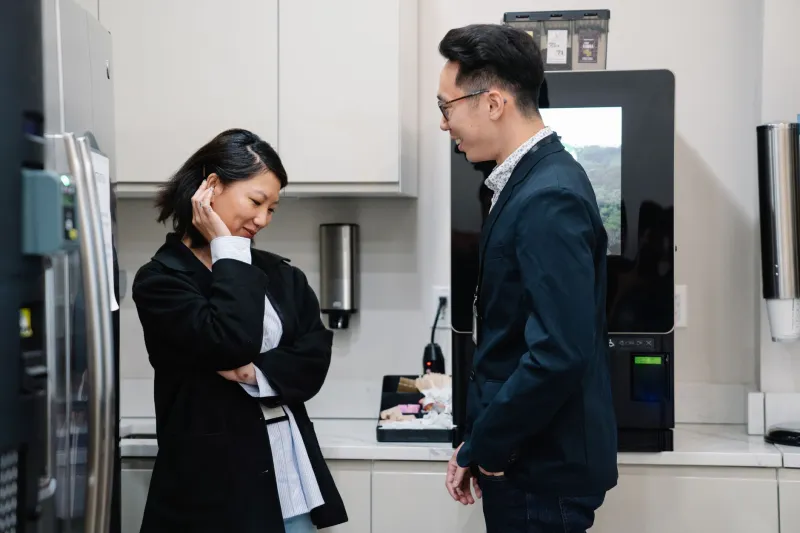
Every December, somebody gets voluntold. The holiday party has a budget line for coffee, the breakroom supply order is due, and somehow your name is on it. Congratulations. You are now the office coffee person.
The instinct is to grab the biggest tub of pre-ground on the shelf and be done. Resist it. Not because you're a snob, but because the breakroom is a genuinely hostile environment for coffee — hot plates that hold a pot at 195°F for three hours, brewers that haven't been descaled since the Obama administration, and a rotating cast of people who each have a different opinion about strength. The bean has to do a lot of work.
First: Audit the Setup Before You Buy Anything
Walk over to the breakroom and answer three questions.
- What's brewing it? A commercial batch brewer with a big basket and a server? A consumer drip machine with a glass pot and a hot plate? A thermal carafe that holds temp without heat? Each one changes what you should buy.
- How long does a pot sit? If the answer is "until it's gone, usually two hours," you need a coffee that stays decent as it cools. If it's "ten minutes, these people are animals," buy for volume and freshness instead.
- Is there a grinder? A real burr grinder changes everything. No grinder means you're buying pre-ground, and that decision needs to be made carefully — see below.
The Batch Ratio That Actually Works
Most office coffee tastes weak because the person brewing uses the scoop that came with the machine and fills the basket halfway. Here's a number to tape to the wall:
1 gram of coffee to 17 grams of water. For a standard 12-cup batch brewer (about 60 fl oz, or 1,800 ml), that's roughly 100 grams of coffee — a little over 3.5 ounces by weight, which is much more than it looks like.
If the office buys by volume, buy a cheap kitchen scale for the breakroom. It'll pay for itself in a month because you'll stop over-brewing weak pots that people dump out.
Also: use filtered water. If the tap tastes like a swimming pool, the coffee will too, and no bean on this list can save it.
The Keep-It-Drinkable Schedule
Coffee on a hot plate degrades on a predictable curve. Print this and stick it next to the brewer.
- 0–20 minutes: Peak. Drink it.
- 20–45 minutes: Still fine. Slightly flatter, more roast-forward. Acceptable.
- 45–75 minutes: Getting stewy. The edges turn metallic. This is where you brew a fresh half-batch instead of topping off.
- 75+ minutes: Dump it. Yes, it feels wasteful. No, nobody is going to drink it, and leaving it there makes the whole room smell like burnt toast.
If you have a thermal carafe, you get closer to two hours of usable coffee — but preheat it with hot water first, and never leave the lid off.
Six Bold Profiles, Matched to the Machine
1. The full-city dark blend — for thermal carafes. Look for something with Sumatra or Brazilian components and a roast deep enough to show dark chocolate and cedar. These hold their shape as they cool, which is exactly what a thermal carafe asks for.
2. The medium-dark Colombian — for glass-pot hot plates. A coffee with a little more acidity and caramel sweetness survives heat-holding better than a very dark roast, which turns ashy fast on a burner. This is the workhorse pick for the classic breakroom setup.
3. The dark breakfast blend — for big batch brewers. Commercial brewers run hot and fast, so a sturdy blend with body to spare won't taste hollow. Aim for something described as bakers' chocolate, toasted nuts, and low acidity.
4. The Swiss-water-process decaf dark — for the afternoon pot. Nobody wants to be the person who drank regular at 4 p.m. and stared at the ceiling until midnight. A good decaf dark roast tastes like coffee, not like a compromise — the water process keeps the sweetness intact.
5. The whole-bean espresso-leaning dark — for offices with a grinder. If someone fought for a burr grinder, reward them. A dark roast built for espresso also pulls beautifully as a strong batch brew at 1:15, and gives the office a second option for the person who wants a shot after lunch.
6. The single-origin dark from a local roaster — for the small office that actually drinks it. Ten people, one pot a day, a roaster within driving distance? Buy whole bean, buy two weeks at a time, and buy local. This is the only scenario where a rotating single-origin makes sense for an office, and it's a great one.
Skip These Shortcuts
- Flavored pre-ground. Hazelnut vanilla caramel isn't a coffee, it's a candle. Someone will complain and they'll be right.
- Bulk pre-ground in a giant tub. Pre-ground coffee stales in days, and those tubs sit on shelves for months. If you have no grinder, buy pre-ground in small bags from a roaster that grinds to order — ask for batch-brewer or drip coarseness, not "regular."
- Buying one kind for forty people. Get two: a bold regular and a dark decaf. Two pots, two carafes, no arguments.
- Forgetting to clean the machine. A dirty brewer makes every bean taste like last week's bean. Run a descale before the holiday rush and rinse the basket daily.
The Real Goal
Office coffee doesn't have to be good in a specialty-café sense. It has to be good in a nobody-complains sense: hot, not stewed, strong enough to notice, and fresh enough that people go back for a second cup. Buy bold, grind coarse, weigh your batch, and dump the pot before it turns. That's the whole holiday playbook — and you can go back to planning the party.